Reflexiones sobre temática variada, en su mayoría de índole filosófica.
ARTES, CIENCIAS y LETRAS
Categoría: Reflexiones
«Déjate de musiquitas…» – El Roto -
enero 14, 2014 por
Agustín Barahona
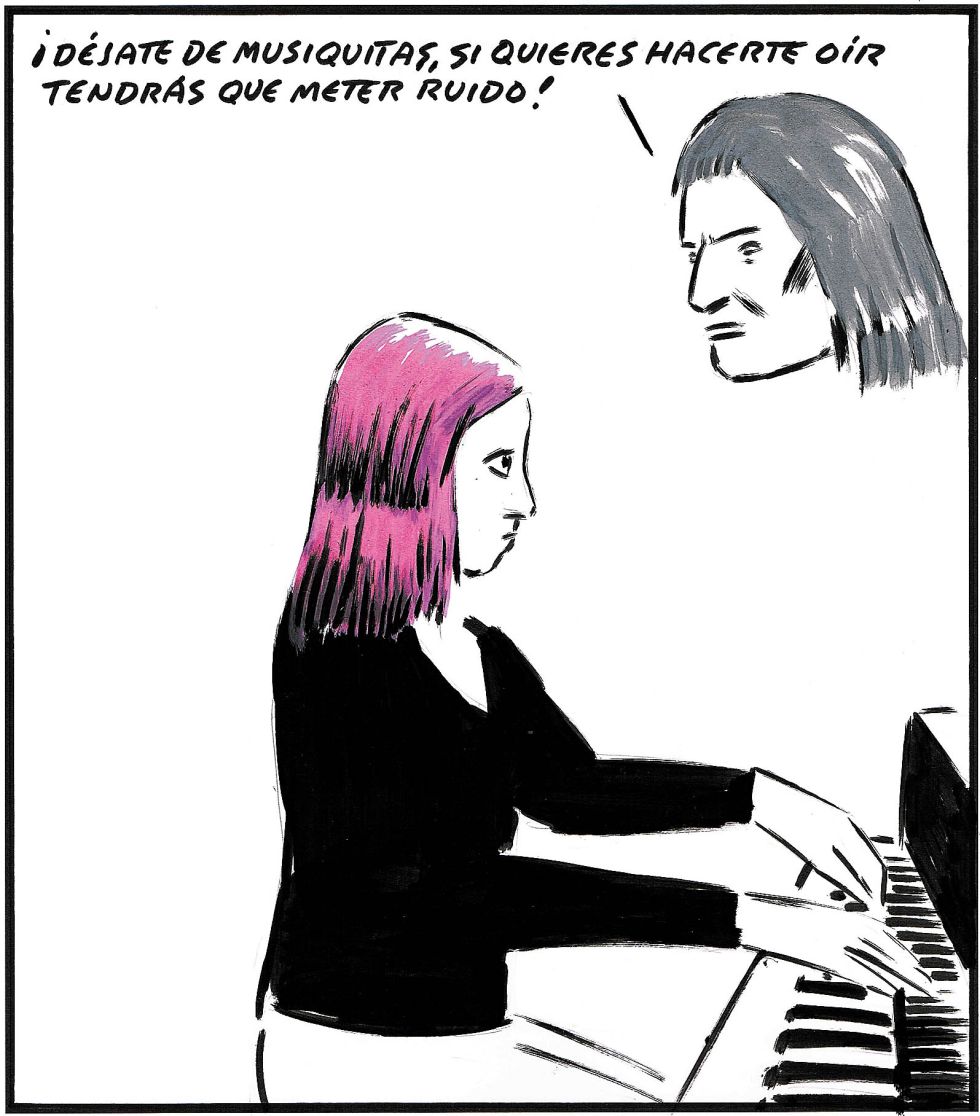
Como si el genial El Roto hubiera estado leyendo mi facebook las pasadas semanas 🙂
Al igual que la viñeta de El Roto define perfectamente la idiosincrasia de las producciones sonoras que quieren hacer pasar por música clásica –ni más ni menos– y que son hechas por la gente que aún está en el poder en estos momentos, esta otra de Forges define muy bien este otro aspecto de la triste realidad institucional orquestal española:
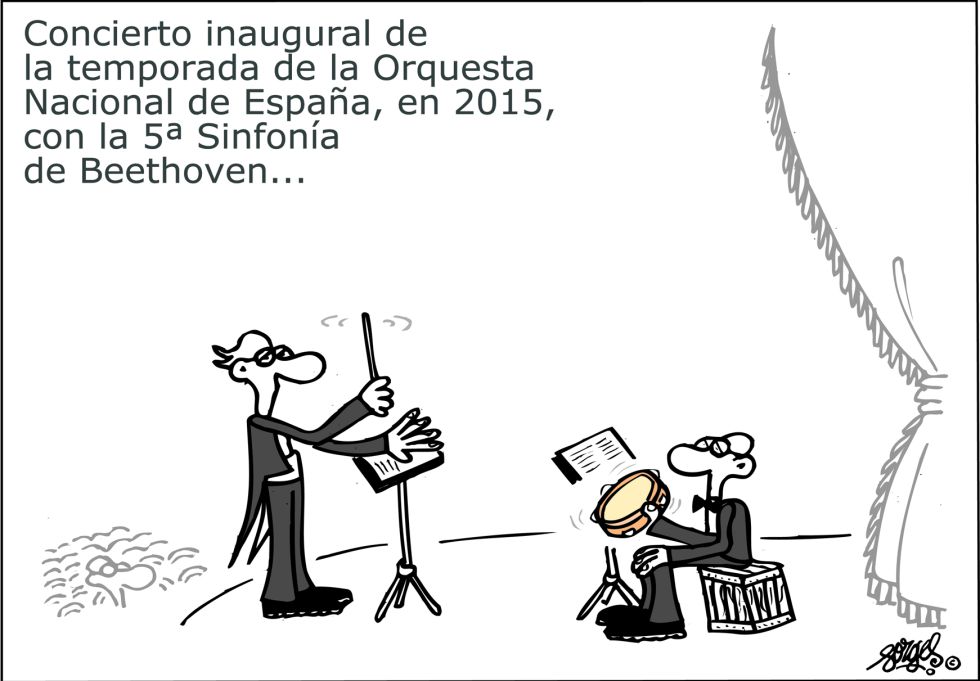
Y la segunda es en parte efecto de la primera.
Sólo con argumentos racionales puede convencerse a… -
enero 13, 2014 por
Agustín Barahona
«Sólo con argumentos racionales puede convencerse a las personas racionales. Sólo con argumentos sentimentales puede convencerse a las personas sentimentales. Pero es imposible convencer a quien no desea ser convencido. Ése ha sido es y será siempre el problema de la Educación: sin la real Voluntad de estar lo más cerca posible de la Verdad es imposible evolucionar.» [Agustin Barahona]
¿Por qué enseñamos música…? -
enero 13, 2014 por
Agustín Barahona

«Only one important and transcendental clarification:
Unless we are talking about the classical graphical notation system –if it were the modern one it is not even a graphical language, strictly speaking, but kind of a «glossarified idiolectic cryptography» for each author–, the only point where I must disagree is the third one: music is not a foreign language, unless we’re thinking about the kind of sound productions such as extreme atonality –as a nuclear method, not as a resource– and noise because of noise, all of them getting the public to understand nothing. In that case, yes, I would agree that it is a foreign language, but I’m afraid that is not music because of those very reasons
Music is the same language organ in the brain, well articulated, but devoted to those ineffable aspects of the communication which are based on feelings and emotions and it is an universal competence. Also, the most universalized musical language is tonality, which has a strong natural justification. With thousand of years in its background and natural evolution, tonality is based in an universal system of natural hierarchical order of sounds and structures derived from the physical nature of sound –sixteen first more or less audible overtones– and hence tendent to be repeated everywhere, without a previous education, in every primitive human group, as anthropology and neuromusicology are starting to prove and spread and ethnomusicology had postulated long time ago.
Thus, music is not a foreign language but, contrarily, our inner natural language to narrate and articulate our own feelings and emotions not communicable by means of speech.
So, every time we spread the text we are commenting, I would suggest to replace that third point with:
III.- Music is our natural language to communicate the ineffable.
Or even, establishing a parallel with what is intended to be communicated in the entire text:
III.- Music is Language.» [Agustín Barahona]